The praxis text book will become available in July 2026. It can be now pre-ordered.
From the foreword by C.R. Lama:
The title of this book is Drowa Kundrol. “Drowa” (‘Gro Ba) means moving, going, that is all sentient beings, all who possess a mind. Although in English tables and houses could also be said to move if someone moves them, Drowa refers only to those who move by the force of their minds. Kun means all, everyone, completely. “Drol” means liberation (Grol) free, or taken out (sGrol).
Now who is taking out whom? Arya Avalokiteshvara Chenrezi (sPhyan Ras gZhigs) is the one who is taking out and his object is all sentient beings without any partiality or exceptions. They must come free from this world which is like a great ocean of suffering. Chenrezi takes them out into the open joy of enlightenment. Chenrezi is clearly described in the text in the section on praising his symbols (rTags bsTod) …
Rigdzin Godem or Ngödrup Gyaltsen (1337 – 1408)
The great holder of the lineage and treasure revealer Ngödrup Gyaltsen was the reincarnation of Nanam Dorje Dudjom, one of Padmasambhava’s principal disciples. He was born on 10th day of the 1st month of the Fire Ox year (1337), accompanied by extraordinary signs. He was the son of Master Dudul, who belonged to an unbroken lineage of realised masters of Vajrakila, tracing back to the clan of the Horpa King Kurser.
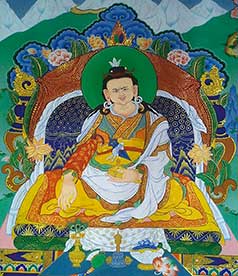
In accordance with a prophecy, three vulture feathers grew from the crown of Ngödrup Gyaltsen’s head when he was twelve years old, and five when he was twenty-four. For this reason, he became widely known as the ‘Bearer of Consciousness with the Vulture Feathers’.
At dusk on the fourth day of the sheep month, 14 June 1366, Rigdzin Godemchen discovered a large, profound treasure on the slope of Mount Tukdrul Pungdra, contained within a square blue box, which held five treasure chambers with separate compartments. This contained many ritual objects and scrolls, all the teachings that Nanam Dorje Dudjom had received from Padmasambhava, known to this day as the Northern Treasures (Tib. Byang gTer), of which Drubkor Namsum (Tib. sGrub sKor rNam gSum) is a significant cycle.
Chimed Rigdzin Rinpoche (1922 – 2002)
was born in 1922 in Kham, Eastern Tibet. At the age of four, he was recognised as the reincarnation of the great Siddha Yogi Nuden Dorje, who in turn was the reincarnation of Khyeuchung Lotsawa (one of Padmasambhava’s 25 principal disciples).
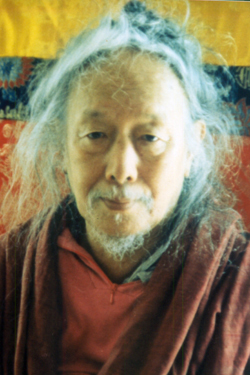
From 1954 to 1987, Rinpoche lived in Shantiniketan, where he taught as Director of the Institute of Tibetan Studies at Vishva-Bharati University. During this time, with the assistance of Western students like James Low and Martin Boord and Tibetan scholars, he translated many texts of the Nyingma tradition, primarily from the Byang gTer and ´Khor gDong treasure text (terma) lineages.
Following his retirement in 1987, Rinpoche travelled regularly to Europe and America, where he also began to disseminate Buddhist teachings in general and, in particular, the terma teachings of Padmasambhava. In India and Poland, centres for Buddhist studies and practice were established by his disciples at Rinpoche’s request, where Rinpoche’s teachings are preserved and passed on.
With Tibetan, phonetic transcription, word-for-word translation, line and verse translation — for easy recitation and practice; sewn binding for daily use.
edition khordong at Wandel Verlag, berlin 2026, Hardback, 332 pp., sewn binding, 15×22cm, 650g, 40€, 30.06.2026, ISBN: 978-3-942380-39-3